
1 Introduction
Ecological networks provide one of the most powerful frameworks for understanding how biodiversity is organised and how ecological communities respond to environmental change. Historically, food web research focused largely on describing structural properties such as connectance, trophic organisation and degree distributions, revealing remarkably consistent patterns across ecosystems (Williams and Martinez 2000). Increasingly, however, the focus has shifted from describing network architecture to predicting ecological processes. Mechanistic dynamic food web models now allow researchers to investigate community stability, biomass dynamics, extinction cascades and ecosystem responses to perturbation by explicitly simulating the transfer of energy through interacting species (Yodzis and Innes 1992; Brose et al. 2006; Curtsdotter et al. 2011; Delmas et al. 2017). These approaches represent an important advance over purely topological analyses because secondary extinctions emerge from ecological dynamics—including resource limitation, interaction strengths and feedbacks—rather than simply from the structural loss of trophic links. As a result, dynamic food web models are increasingly used to address questions spanning conservation biology, ecosystem functioning and macroecological responses to environmental change.
Despite these advances, the application of dynamic food web models remains constrained by an often overlooked problem - the nature of the network used as model input. Dynamic simulations require a realised interaction network representing trophic interactions that can occur simultaneously within a community, yet the networks used to construct these models vary considerably in both their provenance and ecological representation. Synthetic networks, such as those generated by the Cascade (Cohen et al. 1985) and Niche (Williams and Martinez 2000) models, provide useful theoretical abstractions of food web structure and can be readily coupled to dynamic models, but are not intended to represent particular communities. More detailed networks can instead be constructed from empirical observations or inferred using biological information such as body size, energetics and trophic constraints. Mechanistic approaches such as the Allometric Diet Breadth Model (ADBM; Petchey et al. (2008)) and Allometric Trophic Networks (ATNs; Brose et al. (2006)), for example, can generate empirically parameterised networks. However, these models require detailed data (abundances and body sizes) and it remains to be seen if they are able to accurately recover specific pairwise interactions as they do not account for trait-based compatibility between specific species pairs (Strydom, Dunhill, et al. 2026; Strydom, Karapunar, et al. 2026). Conversely, a literature- or inference-derived metaweb only represents feasible pairwise interactions for species in a community (Dunne 2006).
This distinction is important because empirical provenance does not necessarily imply realised ecological structure. Metawebs can incorporate substantial information about real ecological interactions while aggregating interactions observed or inferred across locations, seasons, sampling periods or environmental contexts (Dunne 2006). They therefore provide a potentially powerful empirical basis for dynamic modelling, but typically contain more interactions than are realised simultaneously within any particular community. For regional metawebs, exploiting this information in a dynamic framework consequently requires an additional network realisation step - selecting from the pool of potential interactions to generate plausible community-level networks. Such network realisation is more than a computational reduction in connectance; it is an ecological modelling decision that determines which interactions are assumed to occur together.
The need for ‘metaweb realisation’ is particularly apparent when considering ecological systems for which dynamic predictions could be most informative but empirical data are inherently incomplete. Palaeoecological records, for example, can provide unusually valuable opportunities to study the ecological consequences of major extinction events because fossil assemblages can document communities before and after large-scale biodiversity loss (Roopnarine 2017; Roopnarine 2006; Fricke et al. 2022; Dunhill et al. 2024; Karapunar et al. 2026). Yet even where species composition and trophic interactions can be reconstructed, palaeoecological data rarely provide a complete observation of a single realised food web. Instead, they are more naturally used to reconstruct empirically constrained interaction pools from which plausible community networks can be inferred. This creates an opportunity for dynamic food web modelling - provided metawebs can be converted into dynamically viable realised networks. Empirically-informed ecological change has the potential be used to test mechanistic explanations through comparisons before and after extinction event or more complex hindcasting exercises (Strydom, Catchen, et al. 2021).
However, the process of metaweb realisation itself has the potential to introduce assumptions that may propagate into subsequent ecological inference. In this sense, realised-network generation constitutes an ecological model in its own right, introducing structural assumptions before any population dynamics are simulated. These assumptions may then be compounded by the dynamics themselves. Once a realised network has been generated, dynamic models typically undergo a burn-in period during which biomass redistributes and species unable to persist under the chosen dynamical formulation are lost. Burn-in therefore represents a further filtering step, transforming a structurally feasible network into a dynamically viable community. Only after these successive stages of network realisation and dynamical filtering are perturbations, such as species removals or environmental change, imposed. Ecological inference from dynamic food web models is consequently conditioned not only by the dynamical formulation of the model, but also by assumptions introduced during network construction and by the subsequent process of dynamical realisation.
Here we investigate whether alternative approaches to network realisation influence the behaviour of subsequent ecological models. Using empirical metawebs, we generate ensembles of realised food webs using four ecologically motivated downsampling algorithms representing contrasting hypotheses about interaction realisation, alongside networks generated using the Niche and ATN models as additional reference approaches. We then evaluate how these alternative assumptions influence network structure, dynamical burn-in, and extinction responses. Our objective is not to identify an optimal downsampling algorithm, nor to suggest that any single approach provides the correct realised community. Rather, we use network realisation as a proof of concept for integrating empirical interaction pools into dynamic food web models, asking whether the ecological signatures introduced during network construction remain detectable throughout subsequent dynamical modelling. More broadly, we ask whether realised metawebs can provide a viable bridge between observed ecological interaction structure and mechanistic dynamic modelling, and whether the assumptions required to construct that bridge ultimately become as influential as the ecological dynamics themselves.
2 Methods
2.1 Data
We used community data from seven locations compiled by Karapunar et al. (2026). The dataset comprises community-level trophic data representing potentially interacting taxa across these locations. We used guild-level rather than species-level data to keep network size manageable and within the range examined by Curtsdotter et al. (2011). To extend the basal component of the networks and better represent a realised community, we additionally incorporated plankton and zooplankton data from the outputs of the EcoGEnIE models (Ward et al. 2018) used in Karapunar et al. (2026). Each location was treated as a community of potentially interacting taxa, with interactions represented at the guild level. We excluded the community from Russia because it contained no intermediate species and was therefore unsuitable for the subsequent network analyses. Detailed descriptions of the underlying community data, including trait assignment, their composition and spatial structure, are provided by Karapunar et al. (2026).
2.2 Network construction
For the empirical networks, we used the Paleo Food Web Inference Model (PFWIM; Shaw et al. (2024)) to infer trophic interactions from discrete ecological trait categories. PFWIM applies a set of mechanistic feasibility rules to consumer–resource pairs, with an interaction inferred only when the relevant trait combinations satisfy the specified rules. To maximise the breadth of plausible interactions given the available trait data, we used fully categorical rules rather than imposing more restrictive continuous or quantitative thresholds. The resulting PFWIM networks were used as community-specific metawebs, from which networks were subsequently downsampled to specified target connectances (see Section 2.3 for details on downsampling).
We additionally generated niche-model networks parameterised using the species richness and target connectance of each community (Williams and Martinez 2000). Finally, we constructed allometric trophic network (ATN) model (Brose et al. 2006), providing a complementary mechanistic representation of trophic interactions based on consumer–resource body-size relationships.
2.3 Downsampling approaches
We treat downsampling as a process of ecological realisation rather than observation. Starting from a metaweb containing all potential trophic interactions, each downsampling approach represents an alternative ecological hypothesis describing how local ecological processes filter these potential interactions into the subset that is realised within a particular community. The different approaches therefore differ not only in their implementation, but also in the ecological assumptions they embed about how realised food webs emerge from a common regional interaction pool.
2.3.1 Niche
The original niche model from Williams and Martinez (2000) assumes that realised interactions represent the core of a consumer’s trophic niche, and that these diets can be arranged along a single niche axis. In order to create a downsampling approach that mimics this we we infer a latent trophic axis directly from the metaweb using Singular Value Decomposition (SVD). It has been shown that the latent spaces described by the left and right singular vectors are closely aligned wth the generality and vulnerability of species (Strydom et al. 2022) and so the SVD composition should retain the diet of the species.
Let \(A\) denote the \(S \times S\) adjacency matrix of the metaweb, where \(A_{ij}=1\) if consumer \(i\) feeds on resource \(j\). We compute its singular value decomposition,
\[ A = U \Sigma V^\top \]
where \(U\) and \(V\) are the left and right singular vectors, respectively, and \(\Sigma\) is the diagonal matrix of singular values. Using the leading singular value, \(\sigma_1\), and corresponding singular vectors, \(\mathbf{u}_1\) and \(\mathbf{v}_1\), each species is assigned latent consumer and resource coordinates,
\[ c_i = \sqrt{\sigma_1}\,u_{i1}, \qquad r_i = \sqrt{\sigma_1}\,v_{i1} \]
Because species can act both as consumers and as resources, these coordinates are combined to obtain a single niche position,
\[ x_i = \frac{c_i + r_i}{2} \]
which is subsequently rescaled to lie between 0 and 1. Species with similar values of \(x_i\) therefore occupy similar positions along the dominant trophic gradient of the metaweb.
For each consumer \(i\), the centroid of its realised niche is
\[ \mu_i = \frac{1}{k_i}\sum_{j \in R_i} x_j \]
where \(R_i\) is the set of resources consumed by species \(i\), and \(k_i\) is its trophic breadth (generality). Niche breadth is estimated as the standard deviation of prey positions,
\[ \sigma_i = \max\left(\mathrm{sd}(x_j),\,0.1\right) \]
where the lower bound prevents unrealistically narrow niches for specialists. Niche breadth can optionally be scaled to further constrain realised diets,
\[ \sigma_i' = \alpha \sigma_i \]
where \(\alpha\) is acts as a scaling parameter.
The probability of retaining an interaction between consumer \(i\) and resource \(j\) is then
\[ P_{ij} \propto \exp\left[-\left(\frac{x_j-\mu_i}{\sigma_i'}\right)^2\right] \]
Interactions closest to the consumer’s niche centre are therefore most likely to be realised (retained), whereas interactions towards the margins of the niche are preferentially removed. Ecologically, this assumes that local communities realise the central portion of a consumer’s potential trophic niche, with peripheral or opportunistic interactions occurring less consistently.
2.3.2 Power-law
The power-law approach assumes that interaction realisation depends primarily on consumer trophic breadth. Following Roopnarine (2006), the retention probability for consumer \(i\) is
\[ P_i \propto \exp\left(\frac{k_i}{E}\right) \]
where \(k_i\) is consumer generality and
\[ E = S^{(y-1)/y} \]
with \(S\) denoting network size and \(y\) the scaling exponent. Probabilities are subsequently normalised to lie between 0 and 1. Every interaction belonging to consumer \(i\) inherits the same retention probability,
\[ P_{ij}=P_i \]
Ecologically, this represents the hypothesis that generalist consumers realise a larger fraction of their potential trophic niche than specialist consumers, irrespective of the identity of individual resources.
2.3.3 Degree-product
The degree-product approach assumes that interaction realisation depends on the centrality of both interacting species. Each interaction is assigned a weight
\[ w_{ij}=k_i^{\mathrm{out}}k_j^{\mathrm{in}} \]
where \(k_i^{\mathrm{out}}\) is the consumer’s out-degree (generality) and \(k_j^{\mathrm{in}}\) is the resource’s in-degree (vulnerability). Retention probabilities are then calculated as
\[ P_{ij} = 1- \frac{w_{ij}}{\max(w)} \]
before being constrained to the interval \([0,1]\). Under iterative downsampling, degrees are recalculated following each interaction removal, allowing probabilities to evolve as the realised network changes. Ecologically, this assumes that highly connected species possess many potential interactions that are not simultaneously realised within any local community, whereas interactions involving more specialised or weakly connected species are more likely to represent essential realised links.
2.3.4 Random
Random downsampling provides the ecological null model. Every interaction has an equal probability of being retained,
\[ P_{ij}=c \]
where \(c\) is constant for all existing interactions. Interactions are removed uniformly at random until the target connectance is reached, subject to the constraint that species cannot become isolated. This assumes that no ecological process preferentially favours the realisation of one potential interaction over another, such that realised food webs constitute an unbiased subset of the regional metaweb that is ultimately only constrained by the number of links.
2.4 Simulations
For each empirical community, we generated 30 replicate network ensembles. Species body masses were sampled independently from truncated log-normal distributions constrained by their categorical body-size classifications but were only used in the construction of the ATNs; for the dynamic simulations body masses were assigned using the predator-prey body mass distribution where body mass (\(M_i\)) is assigned deterministically from the trophic level (\(TL\)) as follows \(M_{i} = Z^{TL_{i}-1}\), where \(Z\) represents the assumed constant predator–prey body-mass ratio, here set to 10. Initial biomasses were drawn from a uniform distribution. These trait values were used to construct a series of alternative networks, representing different two realised networks (ATN and niche model), one metaweb, and four downsampled (realised) metawebs (niche, power-law, degree-product, and random).
For the allometric trophic network (ATN), interaction strengths were generated by varying the feeding threshold between 0.01 and 0.12 and selecting the network whose connectance most closely matched a target connectance. Target connectance was independently sampled for each replicate from a truncated normal distribution bounded between 0.05 and 0.15. The target connectance and richness of the metaweb were used to build a niche model and the metaweb was downsampled until the target connectance was reach. These represent the ‘creation’ networks.
Each creation network was then parameterised using the END package (Delmas et al. 2017) and simulated for up to 5000 time steps. Species whose biomass declined below the survival threshold (\(10^{-12}\)) during this burn-in period were considered extinct and removed from the network. The surviving species and their interactions constituted the corresponding ‘realised’ networks.
Extinction experiments were subsequently performed on both the creation and realised networks. Topological extinction simulations were conducted on both network stages, whereas dynamic extinction simulations were performed only on realised networks. In all simulations, primary extinctions followed one of the prescribed extinction scenarios. During topological simulations, secondary extinctions occurred when species lost all prey, these were allowed to cascade. During dynamic simulations, primary extinctions were imposed by setting the biomass of the focal species to the survival threshold (\(10^{-12}\)), after which the community was simulated for a further 5000 time steps to allow biomass dynamics to relax. Species whose biomass subsequently declined below the survival threshold were recorded as secondary extinctions. This procedure was repeated until the entire community collapsed.
For each extinction scenario, robustness was quantified from the resulting extinction curves as the proportion of primary extinctions required to produce a 50% reduction in species richness (\(R_{50}\) (Jonsson et al. 2015)), estimated by linear interpolation between extinction events.
2.5 Software
Network construction and extinction simulations were run in Julia v1.12.6 (Bezanson et al. 2017), we used EcologicalNetworksDynamics.jl (Lajaaiti et al. 2025) for dynamic simulations, PFIM.jl [REF] for construction of metawebs, FoodWebTools.jl [REF] for network downsampling, and Extinctions.jl [REF] for extinctions and robustness calculations. Statistical analyses were run in R v4.5.2 [REF]. All code can be found at TODO
3 Downsampling and burn-in alter network topology in method-dependent ways
Redundancy analysis (RDA), using permutation-based significance testing while accounting for community-level variation, revealed that downsampling approach significantly affected network topology, but that this effect depended on the magnitude of connectance reduction required to reach the target connectance (999 permutations; \(F_{7, 707}\) = 112.8, \(p\) = 0.001; Figure 1, panel A). The type of network (i.e., downsampling approach) explained 31.8% of total topology variation (adjusted \(R^2\) = 0.318), with community identity accounting for an additional 39.7% of variation. The significant interaction between downsampling approach and connectance change (marginal test; \(F_{3, 707}\) = 18.90, \(p\) = 0.001) demonstrated that topology trajectories differed among downsampling methods depending on the degree of downsampling required. Thus, the extent to which network structure diverged from the original topology depended on both the severity of downsampling and the mechanism by which interactions were removed.
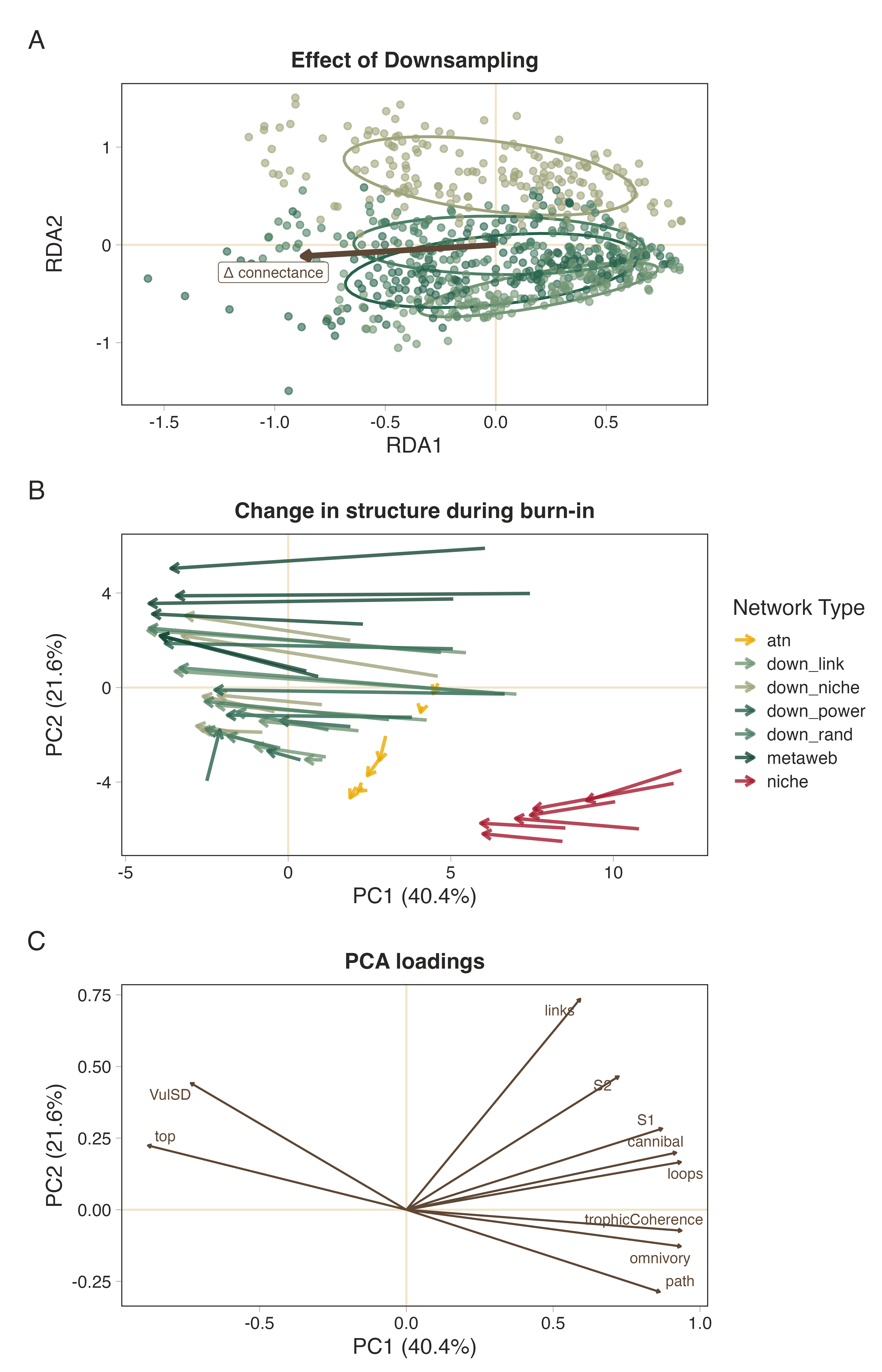
We next asked whether these structurally distinct networks responded differently during the burn-in phase (Figure 1, panel B). Structural reorganisation was quantified as the Euclidean displacement between network positions before and after burn-in in the first three principal component dimensions, with community included as a random effect to account for the substantial variation among communities. Burn-in displacement differed significantly among network types (\(F\) = 62.0, \(p\) < 0.001). Metawebs underwent the greatest structural reorganisation, whereas ATNs exhibited the smallest displacement. Among the downsampled networks, all but the randomly downsampled networks had displacement similar to that of the niche model (Figure S2), while all downsampled networks showed displacement distinct from the original metaweb. When looking at the loadings of the first two PC axes (Figure 1, panel C), the primary changes in structure were related to node-level measures and, unsurprisingly, the number of links. This is to be expected since there is no rewiring of links permitted in this system, and as such any changes should be driven by the loss of nodes rather than a major reorganisation of network structure.
Together, these analyses demonstrate that downsampling approach influences network topology both during the initial downsampling step and during the subsequent burn-in phase. Differences among downsampling methods become increasingly pronounced as greater proportions of interactions are removed, consistent with the expectation that the ecological assumptions underlying each removal strategy would exert a stronger influence under more aggressive downsampling. Importantly, despite generating distinct initial topologies, the different downsampling approaches underwent remarkably similar structural reorganisation during burn-in, changing in ways more similar to the niche model than the original metaweb. This suggests that ecologically informed downsampling of metawebs allows us to produce networks whose subsequent structure more closely resembles that of the niche model, while also suggesting that the burn-in phase is, in and of itself, an additional network realisation step. Notably, the two realised models (niche model and ATN) do not behave similarly and still end up at different ‘end points’ following burn-in compared with the empirical webs, highlighting that network reconstruction approach will still have a strong effect on the inferred dynamics and behaviour of the system (Strydom, Karapunar, et al. 2026).
4 Differences in inferred robustness of topological and dynamic are unaffected by network type
To determine whether the qualitative differences between topological and dynamic extinction simulations previously demonstrated using niche-model food webs generalise across alternative network reconstructions, we compared the difference in robustness (\(\Delta R_{50}\)) among network types for each extinction scenario while accounting for community-level variation. Network type significantly affected \(\Delta R_{50}\) across extinction scenarios (model summaries in Table S1), indicating that the magnitude of the difference between topological and dynamic robustness depended on network reconstruction.
Despite these quantitative differences, the qualitative pattern identified by Curtsdotter et al. (2011) was largely maintained. Under all but random basal removal, topological extinction inferred greater robustness than dynamic extinction for every network type, although the magnitude of this discrepancy varied among reconstruction methods Figure 2. Random basal extinction represented the only notable departure from this general pattern. Here, the discrepancy between topological and dynamic robustness was substantially reduced, with power-law and degree-product downsampled networks exhibiting a slightly higher \(\Delta R_{50}\) and random downsampled networks showing little difference between the two approaches. Thus, the conclusion that topological analyses provide more conservative estimates of robustness, although not universal, remains remarkably robust across reconstruction methods and extinction scenarios.
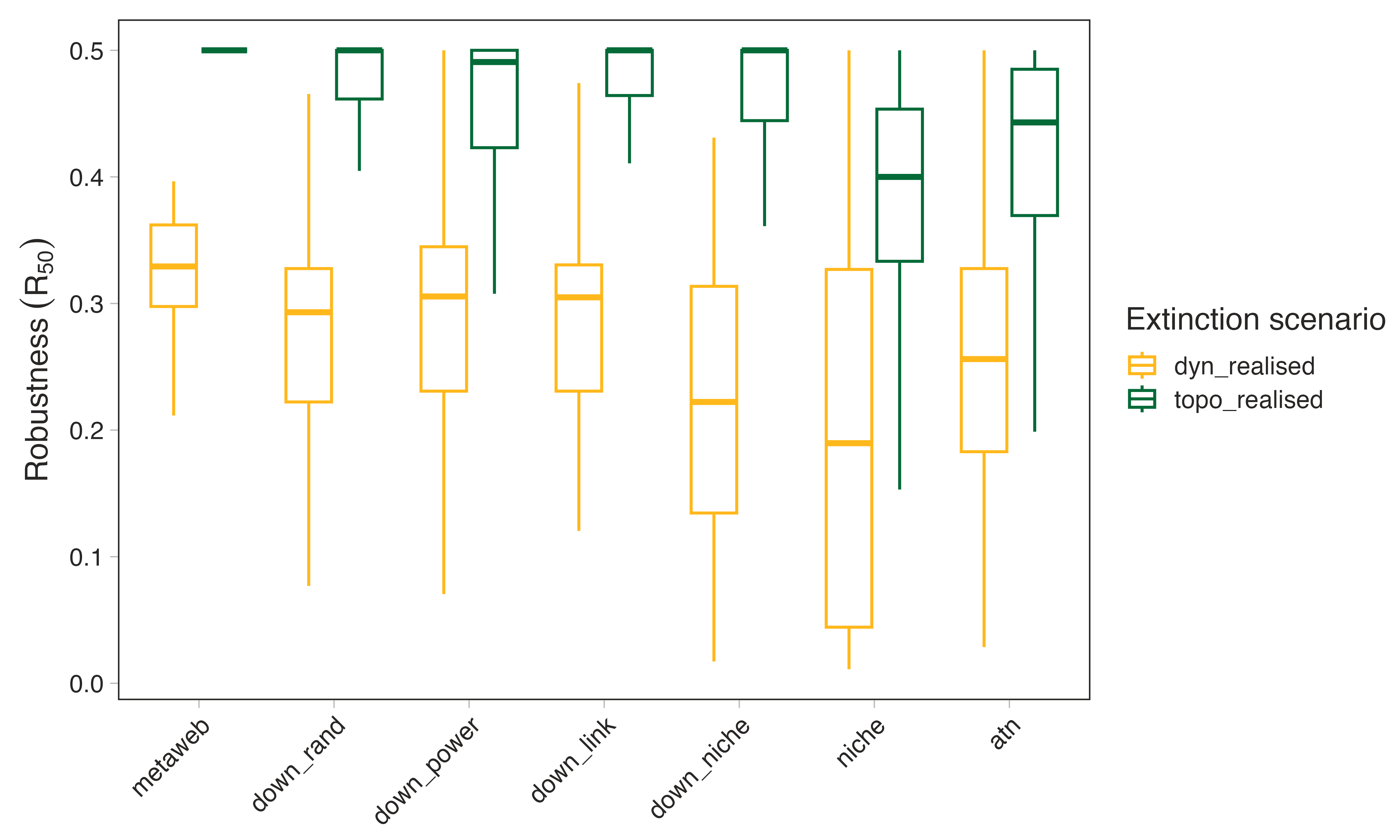
Together, these analyses demonstrate that the principal conclusion of Curtsdotter et al. (2011) extends well beyond the niche model. While the precise magnitude of the discrepancy between topological and dynamic robustness depends on both network reconstruction and extinction mechanism, the qualitative tendency for topological extinction simulations to infer greater robustness than dynamic simulations was recovered across the vast majority of reconstructed food webs examined here.
# Dynamic extinctions re-enforce ecological assumptions
For each community \(\times\) extinction scenario \(\times\) time point, \(R_{50}\) was modelled as a function of network type, and estimated marginal means were compared using Tukey-adjusted pairwise contrasts [SUPP MATT]. Network-type pairs with adjusted \(p \geq\) 0.05 were considered indistinguishable, and the frequency of indistinguishable comparisons was summarised across scenarios [SUPP MATT]. To identify broader groupings of network types, estimated marginal means were standardised within extinction time point, Euclidean distances among network types were calculated, and hierarchical clustering was performed using Ward’s \(D^2\) method.
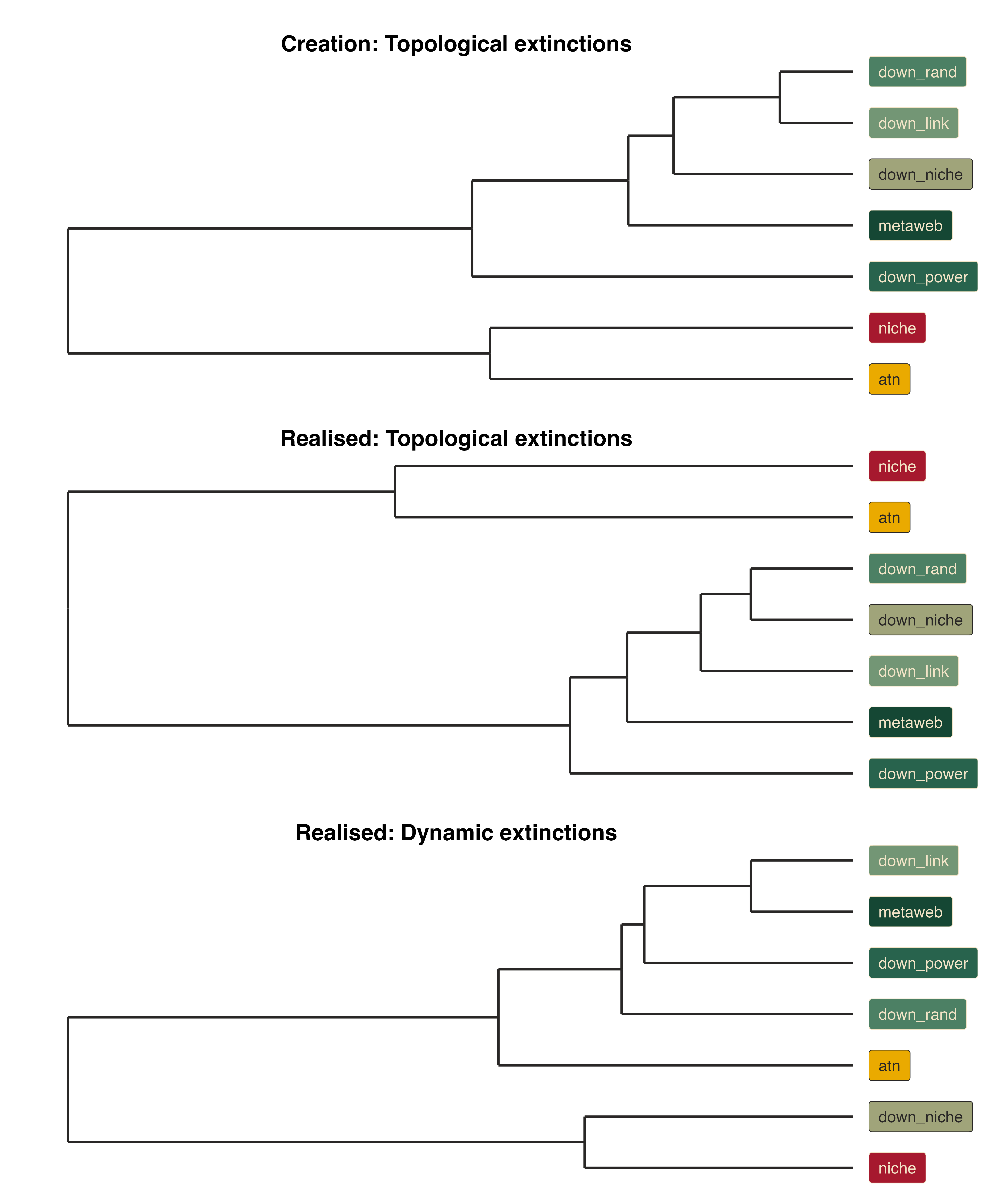
In terms of topological robustness, empirically derived networks consistently formed a distinct cluster separate from the two synthetic networks (niche model and ATN; Figure 3, top two rows). However, under dynamic extinction simulations, this grouping broke down, with a reshuffling of the relative similarity among network types (Figure 3, bottom row). Most notably, the downsampled niche networks yielded robustness estimates that converged with those of the synthetic niche model, whereas the remaining empirically derived networks maintained their mutual similarity. Additionally, the ATN networks shifted to appear more similar in robustness to the empirical cluster.
Topological extinction simulations primarily interrogate network architecture and therefore retain the common structural signature inherited from the metaweb. Dynamic simulations introduce a second layer of ecological structure through biomass- and rate-dependent interactions, revealing differences among networks that are not apparent from topology alone. When examining topological extinctions, it is clear why empirically derived networks behave similarly to one another: they share a common baseline architecture inherited from the regional metaweb (Figure 1, panel B), and topological cascades depend strictly on network topology. For dynamic extinctions, however, network behaviour is not determined solely by initial structure. Instead, higher-order differences emerge from how functional parameterisation interacts with network topology. In the bio-energetic food web (BEFW) framework, species body mass dictates some of the key functional parameters, including metabolic and consumption rates (Delmas et al. 2017), and it is therefore plausible that these differences contribute to the observed similarity in behaviour of the two niche-type networks. Thus, network structure appears sufficient to explain much of the similarity in responses to topological extinctions, but is insufficient to predict responses to dynamic extinctions, where functional parameterisation introduces additional sources of variation. Although the clustering pattern was not universal across communities [SUPP MATT REF], suggesting that network structure still exerts an initial influence, it was not by itself sufficient to determine dynamic robustness.
This raises an important question about the role of network connectance: to what extent does specifying connectance constrain the structural and dynamical properties of generated networks? Work from Poisot and Gravel (2014) and Strydom, Dalla Riva, et al. (2021) shows that less-connected networks can exhibit greater structural complexity, because there are many ways to arrange a small number of links but progressively fewer ways to arrange links as a network approaches full connectivity. At low connectance, we therefore expect a much larger number of possible network configurations, meaning that specifying connectance alone places relatively weak constraints on the precise structure of the resulting network. This provides one possible explanation for why increasingly aggressive downsampling can amplify differences among reconstruction approaches: as fewer interactions are retained, the ecological assumptions used to determine which interactions remain have greater scope to shape the resulting network.
5 Conclusions
Reconstructing realised food webs from regional interaction pools requires assumptions about which potential interactions are likely to occur together. Here, we demonstrate that alternative downsampling approaches can produce dynamically tractable food webs from the same empirical metaweb, but that the resulting networks retain detectable signatures of the assumptions used during their construction. These differences become increasingly pronounced as greater proportions of interactions are removed, indicating that network reconstruction is not a neutral step between empirical data collection and dynamical modelling.
Our results further suggest that dynamical burn-in represents a second form of network realisation. Although burn-in altered the structure of all networks, it did not erase the differences introduced during initial network construction. Instead, the dynamical model acted as an additional filter, determining which structurally feasible networks could persist given its assumptions about biomass, interaction strengths, and species persistence. The ecological behaviour of a simulated community is therefore shaped by successive filters - first, how potential interactions are realised into a network, and second, how that network is realised as a dynamically viable community.
Despite these differences in network structure and dynamical behaviour, the broad relationship between topological and dynamic robustness was consistent across network reconstruction approaches. Topological extinction simulations generally inferred greater robustness than dynamic simulations, consistent with previous work (Curtsdotter et al. 2011). Thus, some conclusions drawn from network topology may be relatively robust to uncertainty in network reconstruction. However, dynamic simulations also revealed differences among networks that were not apparent from topology alone, demonstrating that networks generated from the same empirical interaction pool can exhibit different dynamical behaviour depending on the assumptions used to realise that pool (Strydom, Karapunar, et al. 2026; Brimacombe et al. 2023).
These findings highlight an important challenge for the growing use of dynamic food web models to move beyond describing network structure towards predicting ecological change. Increasingly sophisticated approaches can construct networks from empirical observations or biological traits, while regional metawebs provide a means of retaining broad empirical information on interaction potential. Yet neither empirical provenance nor mechanistic parameterisation necessarily produces a realised community: both require assumptions about which interactions occur together and, in dynamic models, which of those interactions can persist. Network realisation therefore represents a necessary but currently underappreciated bridge between empirical interaction data and mechanistic dynamic modelling.
This distinction may be particularly important for systems in which empirical interaction data are necessarily incomplete, including palaeoecological communities. Fossil records can provide unusually valuable opportunities to examine ecological change across major extinction events, but the interaction data available from such systems are often better interpreted as empirically constrained interaction pools than complete realised food webs. If these pools can be converted into plausible dynamically viable communities, dynamic modelling could provide a route to testing mechanistic explanations of observed ecological change rather than relying solely on topological reconstructions. Our results provide a first step towards this goal, while demonstrating that the assumptions required to construct the network can remain detectable throughout the modelling process.
Rather than identifying a single correct method for constructing realised networks, we therefore argue that network realisation should be treated as an explicit source of ecological model uncertainty. As food web modelling increasingly combines empirical interaction data with dynamical approaches, predictions will depend not only on the equations governing population dynamics, but also on how empirical knowledge is translated into the network upon which those equations operate. Understanding and quantifying this additional layer of uncertainty will be essential if dynamic food web models are to provide increasingly empirical predictions of how ecological communities respond to environmental change.