
1 Introduction
Understanding how biological communities are organised and how species interact with each other is a central goal of ecology. While early efforts focused primarily on species richness and composition, there is growing recognition that ecological communities are structured not only by which species occur, but by how they interact (Thuiller et al. 2024). Interaction networks are increasingly treated as macroecological state variables where they are used to compare community organisation across environmental gradients, quantify \(\beta\)-diversity in interaction structure, evaluate stability–complexity relationships, and infer vulnerability under global change (Tylianakis and Morris 2017; Poisot et al. 2015; Gravel et al. 2019; Trøjelsgaard and Olesen 2016).
As a result, ecological networks now play a central role in comparative analyses spanning latitudinal gradients, disturbance regimes, and deep time environmental transitions (Hao et al. 2025; Michalska-Smith and Allesina 2019; Dunhill et al. 2024; Roopnarine 2006; Poisot and Gravel 2014). Implicit in this expansion is the critical assumption that network properties estimated across systems using various models are structurally comparable, and that differences among network properties reflect ecological signal rather than methodological artefact (Jordano 2016; Fründ et al. 2016). However, most ecological networks are not fully observed as interaction data are incomplete and sampling is uneven across historical and biogeographic contexts, across both present day and deep time (Sandra et al. 2025; Poisot et al. 2021).
Interactions must often be inferred indirectly from traits (e.g., body size), phylogeny, co-occurrence, or theoretical constraints (Strydom et al. 2021; Morales-Castilla et al. 2015). Network construction therefore constitutes a model-based inference step rather than a purely observational exercise. Different reconstruction frameworks encode distinct ecological assumptions about how interactions arise - whether as biologically feasible combinations of traits, energetically optimised realised diets, or topological structures. These assumptions act as structural priors over network architecture (Strydom et al. 2026; Gauzens et al. 2025; Petchey et al. 2011; Guimarães 2020) and begs the question if alternative reconstruction approaches systematically generate different trophic configurations. Risking conflating ecological differences among communities with artefacts introduced by reconstruction choice. The reliability of macroecological inference therefore depends not only on ecological data, but on the structural assumptions embedded in network reconstruction approaches.
Despite rapid methodological development in interaction inference, few studies have directly evaluated how alternative approaches to constructing networks influence macroecological conclusions when applied to the same species pool. This gap is particularly consequential for comparative research, where network metrics are routinely interpreted as indicators of environmental filtering, disturbance intensity, evolutionary history, or community stability (Delmas et al. 2018; Allesina and Tang 2012; Poisot et al. 2015) and begs the question if reconstruction approaches encode distinct structural constraints over interaction topology, then differences among communities may reflect reconstruction assumptions rather than ecological processes.
Deep time ecosystems provide an especially useful test of this issue because trophic interactions are not observed directly and must be inferred from traits, co-occurrence, and theoretical constraints [Dunne et al. (2008); Dunne et al. (2014); Dunhill et al. (2024); Roopnarine (2006); ; Smith et al. (2025)]. As a result, ecological networks in these systems are inherently reconstruction-dependent, rendering the assumptions embedded within different reconstruction frameworks both explicit and consequential. Among such systems, the Early Toarcian Extinction Event (ETEE; ~183 Ma) provides a particularly informative case study. The ETEE was a major Early Jurassic biotic crisis associated with rapid climatic warming, widespread marine oxygen depletion, and substantial ecological turnover (Kemp et al. 2024). Although considered a second-order extinction event globally, it nevertheless resulted in the loss of approximately 26% of marine genera worldwide (Little and Benton 1995). Ecological disruption was especially severe in shallow marine ecosystems, where environmental stress drove extensive restructuring of benthic communities and food webs. In the Cleveland Basin of Yorkshire, the ETEE caused the extinction of around 60% of marine species, including up to 87% of benthic taxa (Caswell et al. 2009). Fossil assemblages from this interval therefore record both the collapse of established communities and the subsequent recovery and reassembly of marine ecosystems under rapidly changing environmental conditions. Recent work has shown that the event selectively impacted specialist and infaunal organisms, leading to simplified ecosystems increasingly dominated by ecological generalists and opportunistic taxa (Dunhill et al. 2024). These changes were accompanied by major shifts in community structure, trophic interactions, and ecosystem connectivity, with evidence suggesting that ecological recovery following the extinction was both prolonged and uneven across marine habitats.
Ecological networks have previously been used to infer patterns of community organisation and extinction dynamics across this transition, providing an ideal test case for evaluating the robustness of network-based inferences of community response. Recent work by Dunhill et al. (2024) has used reconstructed food webs to draw ecological conclusions about community stability and collapse during this event. This creates a rare opportunity to ask a more general question - to what extent are such inferences contingent on the specific reconstruction framework used to generate the network?
Here, we reconstruct ecological networks for four successive assemblages across the ETEE using six contrasting reconstruction frameworks spanning feasibility-based, realised, and structural models. Holding species composition constant while varying only the reconstruction approach allows us to explicitly evaluate whether conclusions drawn from a single reconstruction approach (such as those of Dunhill et al. (2024)) are robust to alternative, equally plausible representations of interaction structure, or whether different reconstruction choices would lead to fundamentally different ecological inferences. More broadly, our study tests whether macroecological conclusions derived from ecological networks reflect underlying biological processes or are conditioned by the assumptions embedded within the reconstruction framework itself.
2 Methods
2.1 Study system and fossil data
We used fossil occurrence data from the Cleveland Basin, UK, spanning the late Pliensbachian to the late Toarcian. This interval encompasses a major volcanic-driven hyperthermal and marine extinction event. To capture network dynamics across this transition, we defined four successive palaeo-assemblages: pre-extinction (Pliensbachian), post-extinction (early Toarcian), early recovery (early–middle Toarcian) and late recovery (late Toarcian). Each taxon was characterised using their size and Bambach’s ecospace framework (Bambach et al. 2007), coding for tiering, motility, and feeding mode as per Dunhill et al. (2024). Each assemblage was treated as a community of potentially interacting taxa. The dataset includes 57 taxa across diverse groups (e.g., cephalopods, bivalves, and gastropods). See Dunhill et al. (2024) for detailed descriptions of the dataset, including taxonomic composition, trait coding, and temporal resolution.
2.2 Network reconstruction approaches
2.2.1 Conceptual classification of network types
Ecological network reconstruction encompasses a range of approaches that differ in how trophic interactions are inferred and in the ecological assumptions they encode. These approaches can be broadly grouped into three classes: feasibility-based, realised, and structural models. Together, these classes represent distinct hypotheses about how interactions arise and constrain the space of possible food web structure (Strydom et al. 2026).
Feasibility-based models infer the set of potential interactions among species based on trait compatibility or mechanistic rules. These approaches define a feasible interaction space by identifying which consumer–resource pairs are biologically possible, without specifying which interactions are realised in each community. In palaeoecological contexts, where direct observation of interactions is not possible, such models provide a biologically grounded, formalised representation, of expert knowledge based rules that can be used to infer interactions (e.g., Fricke et al. (2022); Roopnarine (2006); Shaw et al. (2024)).
Realised models aim to approximate the subset of interactions that are expected to occur in practice. These approaches impose additional constraints (such as energetic optimisation, mechanical limits, or probabilistic niche structure) on top of feasibility, thereby generating networks that represent putative realised diets (Schneider et al. 2016; Brose et al. 2006). Although often parameterised using body size or related traits, realised models differ in their underlying ecological assumptions about how consumers select resources and how trophic interactions are structured.
Structural models, in contrast, do not attempt to reconstruct empirical trophic interactions from species-level data. Instead, they generate networks based on general topological constraints such as species richness, connectance, or trophic ordering (Allesina et al. 2008). These models are species-agnostic and therefore cannot be interpreted as reconstructions of specific ecological communities. Rather, they have the potential to serve as ‘null hypotheses’, providing reference expectations against which the structure and dynamics of data-informed reconstructions can be evaluated.
In this study, we selected models to span these three conceptual classes (Table 1) to sample distinct mechanistic interpretations of trophic interactions rather than exhaustively include all available implementations. Specifically, we include: a feasibility-based model (PFWIM), representing trait-constrained interactions; multiple realised models (ADBM, ATN, and Body-size ratio), capturing energetic optimisation, mechanical constraints, and probabilistic allometric structure, respectively; and structural models (Random and Niche), providing theoretical reference points. Notably some approaches share common inputs (e.g., body mass for ADBM, ATN, and Body-size ratio), they encode fundamentally different assumptions about how interactions arise. Additionally, although other feasibility-based approaches exist (e.g., Roopnarine (2006)), they are conceptually similar to PFWIM in that they infer interactions from biologically feasible consumer–resource combinations. We therefore selected PFWIM as a representative feasibility-based framework because it formalises these rules in a transferable model that can be parameterised across datasets, rather than relying on system-specific expert assignment of links.
| Reconstruction Approach | Assumptions | Data needs | Limitation | Network type | Key reference | Usage examples |
|---|---|---|---|---|---|---|
| Random | Links assigned randomly | Species richness, number of links | Parameter assumptions, species agnostic | Structural | Erdős and Rényi (1959) | Null-model comparisons; testing whether observed network structure (connectance, motifs) deviates from random expectations |
| Niche | Species ordered along a ‘niche axis’; interactions interval-constrained | Species richness, connectance | Parameter assumptions, species agnostic | Structural | Williams and Martinez (2008) | Evaluating trophic hierarchy and motif structure; baseline structural predictions |
| Allometric diet breadth model (ADBM) | Energy-maximizing predator diets | Body mass, abundance/biomass | Assumes optimal foraging; does not account for forbidden links | Realised | Petchey et al. (2008) | Predicting realized predator diets; exploring secondary extinctions |
| Allometric trophic network (ATN) | Links constrained by body-size ratios and functional response | Body mass, number of basal species | Assumes only mechanical/energetic constraints | Realised | Brose et al. (2006); Gauzens et al. (2023) | Simulating species loss; evaluating network collapse dynamics |
| Paleo food web inference model (PFWIM) | Interactions inferred using trait-based mechanistic rules | Feeding traits | Assumes feeding mechanisms; trait resolution required | Feasibility | Shaw et al. (2024) | Mapping feasible trophic interactions; assessing secondary extinctions |
| Body-size ratio model | Probabilistic assignment of links based on predator–prey size ratios | Body mass | Does not account for forbidden links | Realised | Rohr et al. (2010) | Estimating likely interactions; simulating cascading effects. |
This classification allows us to distinguish variation arising from ecological assumptions embedded in reconstruction frameworks from variation attributable to species composition. By comparing networks generated from the same species pool across these complementary model classes, we explicitly evaluate how different representations of interaction structure condition ecological inference.
2.2.2 Network generation and replication
We evaluated six network reconstruction frameworks using the approaches listed in Table 1, expanded descriptions of reconstruction approach assumptions, parameterisation, and link-generation rules are provided in Supplementary Material S1, including full mathematical formulations and parameter definitions. For each community, 100 stochastic network realisations were generated per reconstruction approach (n = 2400 in total, 600 per time bin). Where reconstruction approaches required species body mass or trait values, these were uniformly sampled within the different size classes. We adopted a uniform sampling by default, as alternative distributions (lognormal, truncated lognormal) have negligible impact on topology (Supplementary Material S1; Figure S1). Random and Niche models were parameterised using connectance values drawn from an empirically realistic range (0.05–0.25; Curtsdotter et al. (2011)). For the Random model, which requires link number explicitly, connectance (Co) was first converted to expected link number (L) using \(L = Co\times S^2\), ensuring consistency in network density across all reconstruction approaches. Richness (S) was determined by the number of species for each time bin. For the Body-size ratio model, we followed the approach of Yeakel et al. (2014) using only the body-mass scaling to determine links between species. Sensitivity of network structure to these parameter choices is evaluated in Supplementary Material S1. The PFWIM generates a deterministic feasible metaweb for a given trait configuration. To allow for statistical analyses we introduced variation by applying a downsampling procedure that prunes links (Roopnarine 2006). This step allowed us to introduce statistical variation while still preserving most of the metaweb structure. The choice of downsampling parameter and its effects on network structure are evaluated in Supplementary Material S1.
2.3 Network metrics and structural analyses
We quantified network structure using a suite of network metrics Table 2, capturing overall network properties, motif structure, and species-level variability. Differences among reconstruction approaches were assessed using a multivariate analysis of variance (MANOVA), with reconstruction approach identity as a fixed factor and the full set of network metrics as response variables. Variance partitioning was further assessed using permutational multivariate analysis of variance (PERMANOVA). Pairwise interaction turnover was quantified using link-based \(\beta\)-diversity and was calculated following the framework of Poisot et al. (2012) among the four of the reconstruction frameworks (ADBM, ATN, body-size ratio, and PFWIM). Random and Niche models were excluded because they are species-agnostic reconstruction approaches that generate networks matching broad topological properties (e.g., connectance and degree distributions) rather than predicting biologically realistic species-specific interactions. Specifically, we looked at interaction rewiring among shared species (\(\beta_{OS}\), see S1 for additional details on the decomposition of interaction β-diversity and its implementation), which allows separation of differences arising from altered interaction identities among species common to both networks. Because all networks within a given assemblage are constructed from the same species pool, differences in interaction structure primarily reflect ‘rewiring’ of trophic links due to stochasticity in the reconstruction approach rather than species turnover. All calculations were performed for all reconstruction combinations within the same assemblage (time bin).
| Metric | Definition | Reference |
|---|---|---|
| Connectance | \(L/S^2\), where \(S\) is the number of species and \(L\) the number of links | Williams and Martinez (2004) |
| Maximum trophic level | Prey-weighted trophic level averaged across taxa | Williams and Martinez (2004) |
| No. of linear chains (S1) | Number of linear chains, normalised by \(L/S\) | Milo et al. (2002); Stouffer et al. (2007) |
| No. of omnivory motifs (S2) | Number of omnivory motifs, normalised by \(L/S\) | Milo et al. (2002); Stouffer et al. (2007) |
| No. of apparent competition motifs (S4) | Number of apparent competition motifs, normalised by \(L/S\) | Milo et al. (2002); Stouffer et al. (2007) |
| No. of direct competition motifs (S5) | Number of direct competition motifs, normalised by \(L/S\) | Milo et al. (2002); Stouffer et al. (2007) |
| Generality | Standard deviation of normalised generality of all species within network, normalised by \(L/S\) | Williams and Martinez (2000) |
| Vulnerability | Standard deviation of normalised vulnerability of all species within network, normalised by \(L/S\) | Williams and Martinez (2000) |
2.4 Extinction simulations and their evaluation
Following Dunhill et al. (2024), we simulated species loss from pre-extinction networks under trait-based, network-position–based, and random removal scenarios. Species were deleted sequentially, with cascading secondary extinctions allowed to propagate. Simulated post-extinction states were compared to observed (i.e., reconstructed from fossil occurrence data) networks using mean absolute differences (MAD) of food web metrics (Table 2) and modified true skill statistics (TSS) calculated separately at the node level (species presence/absence) and link level (presence/absence of interactions between species pairs). Scenarios were ranked within each reconstruction framework based on MAD and TSS performance, and Kendall’s rank correlation coefficient (\(\tau\)) was used to quantify agreement in scenario ordering across reconstruction approaches. Detailed implementation of extinction sequences and secondary extinction rules is provided in Supplementary Material S1.
2.5 Software and Reproducibility
Ecological network reconstruction and extraction of structural metrics were conducted in Julia v1.11.4 (Bezanson et al. 2017) using the model implementations provided in Supplementary Material S1. All statistical analyses, including MANOVA, PERMANOVA, and post hoc comparisons, were performed in R v4.5.2 (R Core Team 2024). The full analytical workflow, including data preprocessing, network generation, extinction simulations, and metric calculation, is fully reproducible from the archived codebase.
3 Results
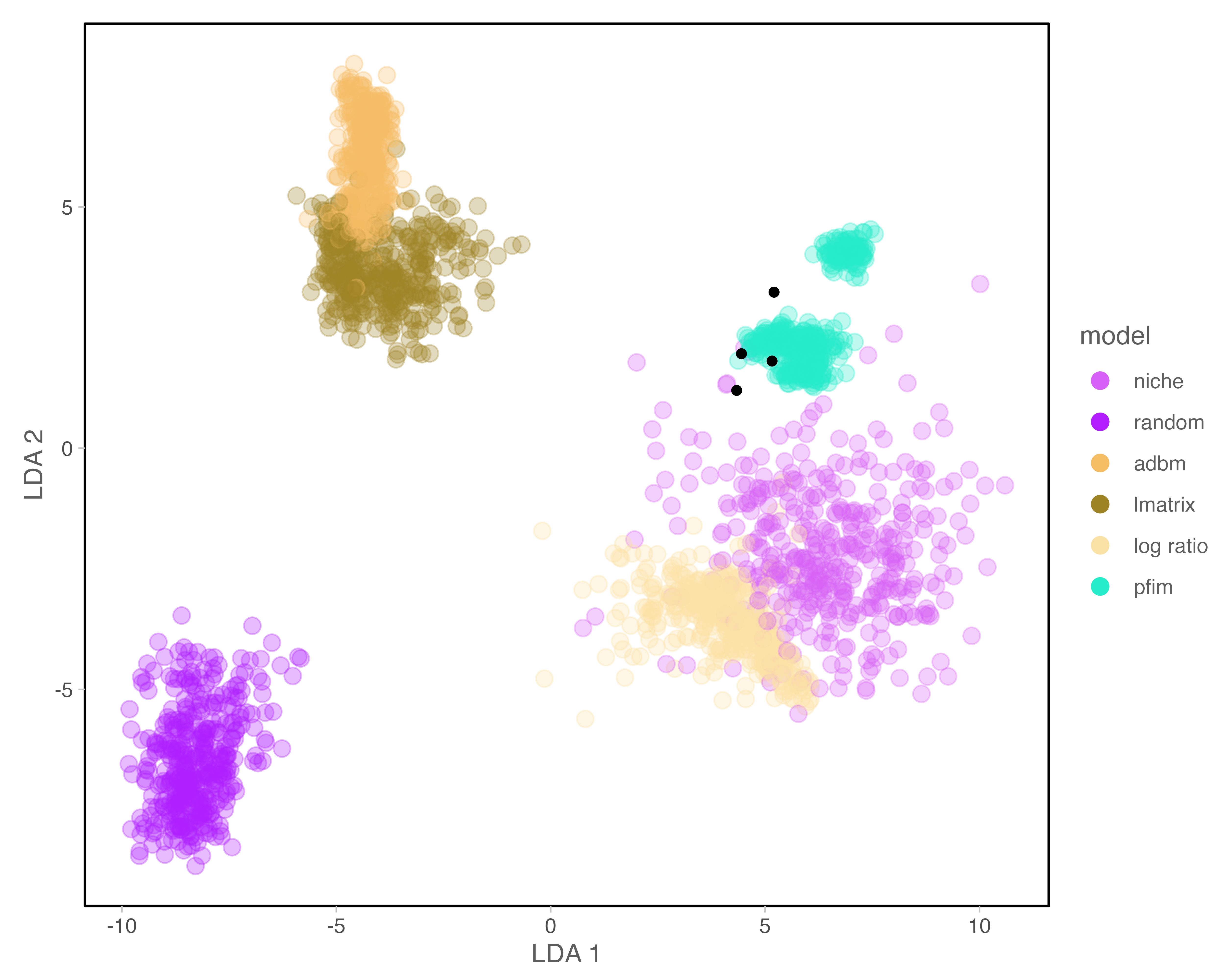
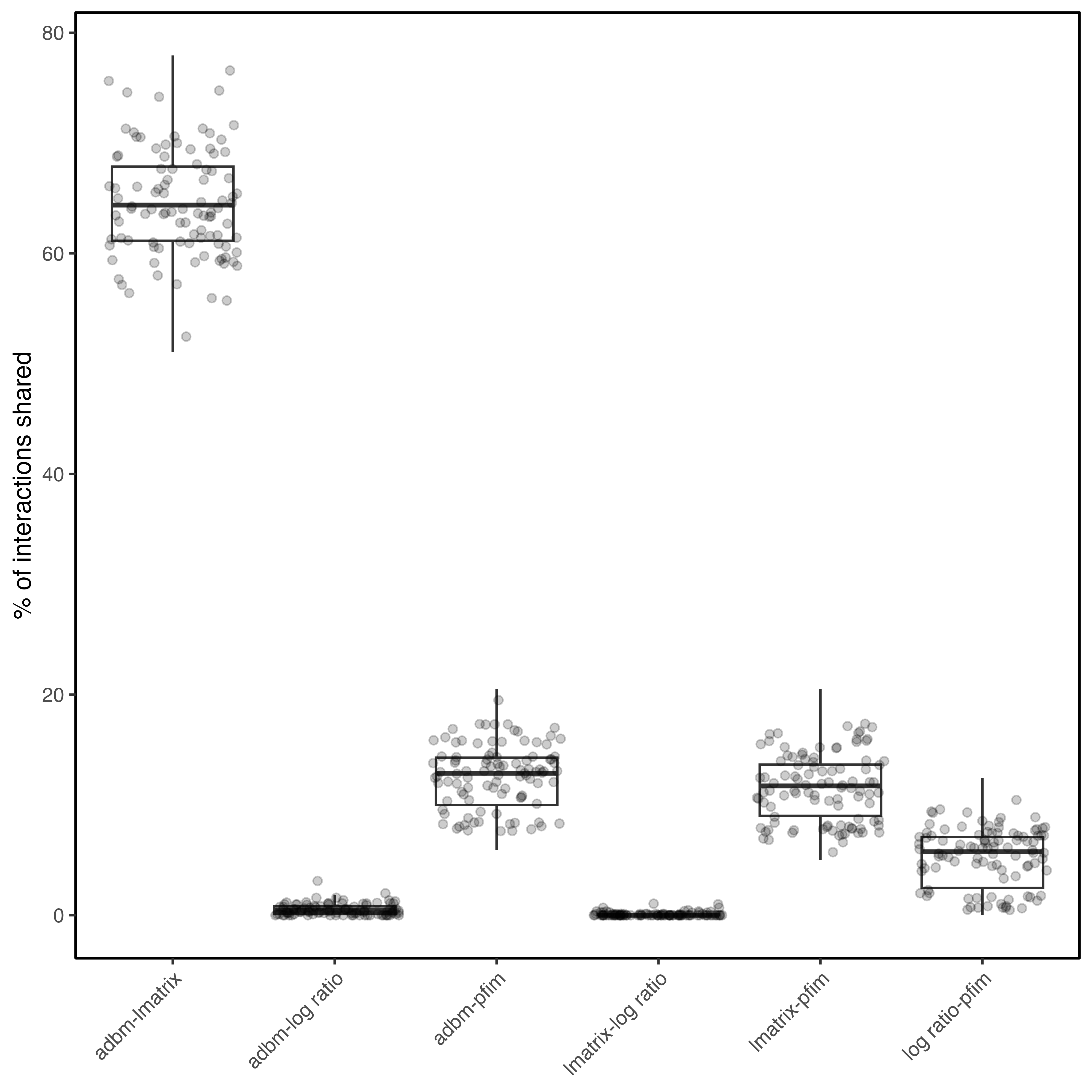
We found that different reconstruction approaches, even those that appeared structurally similar, yielded fundamentally different ecological inferences. Across six reconstruction approaches, inferred food web structure, species interactions, and extinction dynamics differed consistently. Multivariate analyses showed pronounced separation among reconstruction approaches in network metric space (Figure 1), with reconstruction approach explaining most of the variance in structural properties (Figure 2). Notably, approaches that were statistically similar in multivariate structural space often diverged in inferred interactions (Figure 3) or extinction dynamics (Figure 4), demonstrating that structural similarity does not guarantee concordance in species-level diets or inferred behaviour of the system.
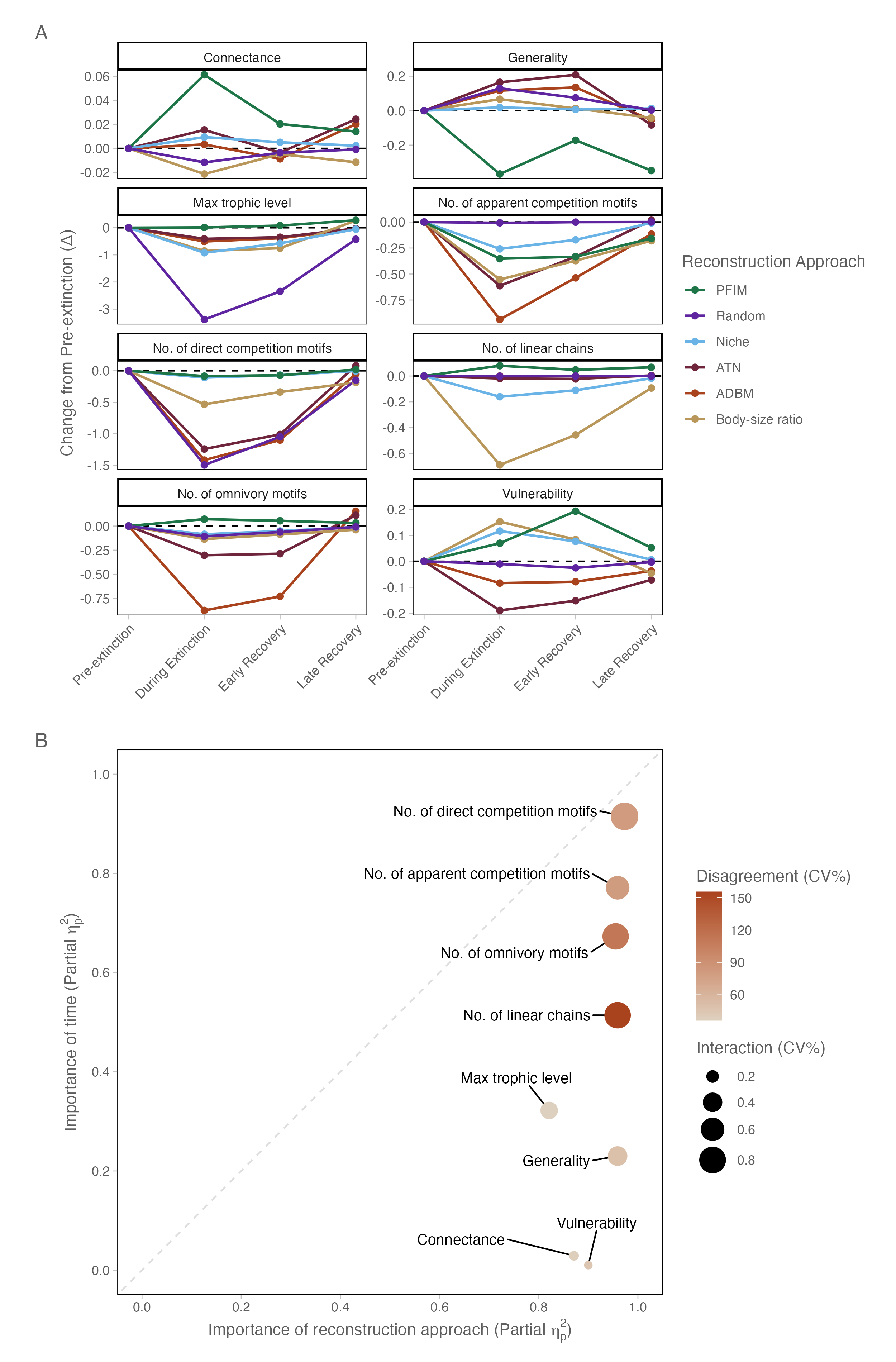
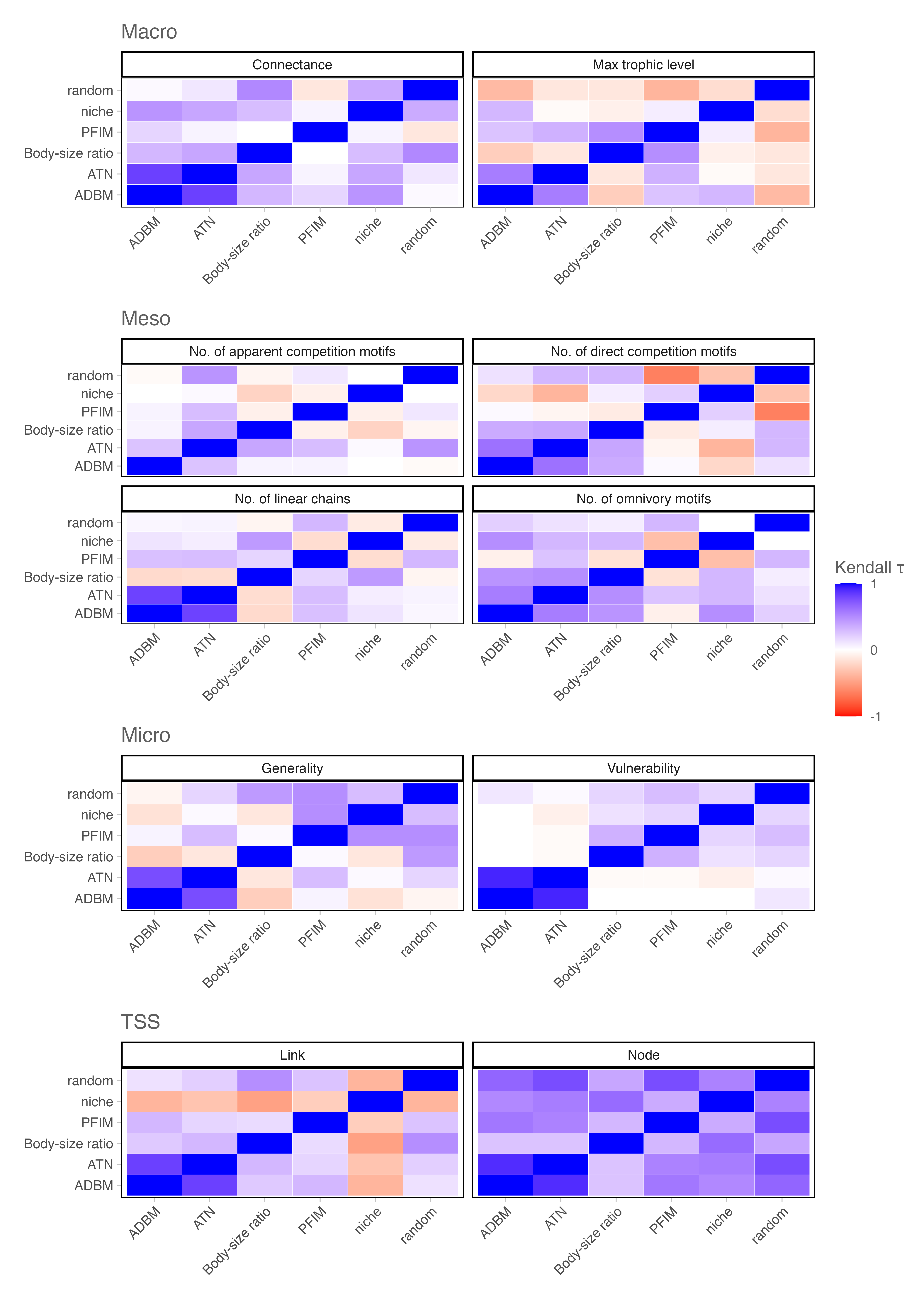
Reconstruction approach substantially influenced inferred extinction dynamics. Temporal trajectories of network collapse, interaction loss, and motif reorganisation differed among approaches (Figure 2). Although node-level extinction rankings were often broadly consistent, link-level outcomes and extinction inferences were highly sensitive to reconstruction assumptions (Figure 4). Together, these results show that ecological inferences drawn from networks depend critically on the reconstruction framework used.
3.1 Network structure differs among reconstruction approaches
Across six reconstruction approaches, network structure (network properties listed in Table 2) differed significantly (MANOVA, Pillai’s trace = 3.84, approximate \(F_{40,11955}\) = 987.35, p < 0.001), indicating that the reconstruction approach systematically alters inferred food web topology. Linear discriminant (LD) analysis identified two dominant axes of variation, explaining 86% of the differences between reconstruction approach. LD1 axis correlated with vulnerability, direct competition motifs, and connectance. LD2 axis correlated with maximum trophic level and apparent competition motifs, reflecting vertical trophic structure (Figure 1; Table S1, Figure S1). The higher-order variates explained less than 9% of the remaining variance.
3.1.1 Variance partitioning of network structure
Permutational multivariate analysis of variance (PERMANOVA) revealed that reconstruction framework accounted for most of the variation in multivariate network structure (\(R^2\) = 0.795, \(p\) < 0.001), whereas temporal turnover across extinction phases explained a comparatively small proportion of variance (\(R^2\) = 0.064, \(p\) < 0.001). The reconstruction approach \(\times\) time interaction contributed a further 7.1% of variance (\(R^2\) = 0.071, \(p\) < 0.001), indicating limited but significant time-dependent divergence among reconstruction frameworks. Thus, differences among reconstruction approaches were more than an order of magnitude greater than structural differences associated with ecological turnover through the extinction sequence, even though the Pliensbachian–Toarcian dataset was characterised with a significant community turnover.
To determine whether the dominance of the reconstruction framework reflected absolute mean shifts among time bins, we repeated the analysis after centring network metrics within each extinction phase. This procedure removes between-phase differences while retaining within-phase structural variation. Even after temporal bin-standardised centring, the reconstruction framework explained 84.8% of multivariate variance (\(R^2\) = 0.848, \(p\) < 0.001). These results demonstrate that the influence of reconstruction approach is not driven by temporal mean differences but reflects intrinsic divergence among reconstruction frameworks in how ecological interactions are organised.
3.1.2 Statistical Drivers of Network Variation
To identify which specific structural properties drive the multivariate separation observed above, we partitioned variance at the level of individual network metrics. Results show that reconstruction choice had a significantly stronger influence on network topology than the ecological signal of species loss. In panel A of Figure 2 for certain network metrics reconstruction approaches predict different responses across time (e.g., connectance), as well as differing magnitudes of change (e.g., the number of apparent competition motifs. A two-way factorial ANOVA across all eight network metrics confirmed that the reconstruction approach was the dominant driver of variance, with partial eta-squared values (\(\eta^{2}_{p}\)) consistently exceeding 0.82 and reaching 0.97 for motifs (Figure 2, panel B; Table S3). While the extinction event (time bin) significantly altered network structure (p<0.001), its relative importance remained secondary, typically explaining a smaller fraction of the total topological variation. This is clear in panel B of Figure 2 where all metrics are within the bottom-right (reconstruction approach-dominated) triangle (below the dashed line), emphasising that framework assumptions outweigh the ecological signal of species loss. Furthermore, the high inter-reconstruction approach Coefficient of Variation (CV) observed for some metrics (Table S4, Figure S4) highlights a sensitivity. The properties that are influenced by time are also those upon which the reconstruction approaches disagree most profoundly. Demonstrating that our understanding of structural food web collapse in the fossil record is highly contingent on the chosen reconstruction framework, particularly when examining complex trophic pathways beyond simple macro-scale properties like connectance.
3.1.3 Inferred pairwise interactions vary widely among reconstruction approaches
Despite some network reconstruction approaches showing similar network metrics, specific pairwise interactions often differed. Pairwise \(β_{OS}\) revealed that certain reconstruction approach pairs shared very few links (Figure 3). Size-based models (ADBM, ATN) were broadly similar due to shared sole reliance on body-size constraints, whereas the Body-size ratio model exhibited consistently higher differences to other reconstruction approaches. PFWIM showed intermediate overlap with body mass-based models. These results demonstrate that agreement in overall network structure does not guarantee agreement in species-level interactions.
3.2 Reconstruction approach choice influences inferred extinction dynamics
To evaluate how reconstruction approach choice affects inferred extinction dynamics, we compared simulated post-extinction networks to observed networks using mean absolute differences (MAD) for network-level metrics and true skills statistics (TSS) for node- and link-level outcomes (Figure 4). Across reconstruction approaches, MAD-based rankings were generally positively correlated (Kendall’s \(\tau\) ≈ 0.13 across structural metrics), indicating weak but generally positive agreement on the relative importance of extinction drivers despite substantial differences in reconstructed network structure. However, agreement within the allometric models (ADMB, ATN) differed from patterns observed for reconstructed network structure.
Node-level TSS rankings were similarly consistent across network reconstruction approaches (Kendall’s \(\tau\) = 0.26 - 0.90), reflecting broadly comparable node-level removal sequences. In contrast, link-level outcomes were far more variable (Kendall’s \(\tau\) = −0.48 - 0.29), highlighting that inferences about which interactions are lost or retained during collapse and recovery are highly reconstruction approach contingent. Together, these results suggest that while alternative reconstruction approaches converge on similar species-level extinction patterns, the inferred pathways of interaction loss and cascading dynamics depend strongly on reconstruction approaches.
4 Discussion
4.1 Network reconstruction is not neutral: structural priors shape ecological theory
Food web ecology has long treated network reconstruction as a methodologically neutral step preceding ecological analysis, with limited attention to how methodological choices might influence outcomes. Once assembled, network properties are generally interpreted as reflections of underlying ecological organisation. This workflow assumes that reconstructed networks provide structurally comparable representations of ecological communities. Consequently, differences in connectance, trophic structure, motif composition, or robustness are typically interpreted as biological variation rather than consequences of reconstruction approach.
Assuming that reconstructed food webs are independent of model choice is particularly critical to evaluate within the context of deep time palaeoecological data. Because interactions in fossil ecosystems are never observed directly, and direct inferences (such as gut contents) are limited, hence they must explicitly be formed through some form of reconstruction approach. This necessity makes the assumptions underlying reconstruction explicit, but also means that ecological narratives are especially sensitive to the chosen reconstruction framework. In these settings the risk is not just incomplete data, but the potential for methodological artefacts to be misinterpreted as genuine macroevolutionary or palaeoecological signals. Consequently, deep time studies offer a unique and stringent testing ground for determining whether community-level responses (such as stability or collapse during mass extinctions) are robust features of the ecosystem or merely byproducts of how we choose to construct the links between species.
Reconstruction framework explained far more variation in food-web topology than temporal turnover across extinction and recovery phases. Across an identical regional taxon pool, alternative reconstruction approaches generated distinct structural signatures that occupied non-overlapping regions of multivariate space (Figure 1), demonstrating that reconstruction approaches produce fundamentally different interaction architectures, independent of temporal turnover in community composition. Even after centring metrics within time bins to remove between-bin mean differences, reconstruction approach remained the dominant driver of structural variation. These results indicate that reconstruction approaches impose distinct ‘structural priors’ on ecological inference, shaping emergent topology, species roles, and predictions of disturbance dynamics. Network structure is therefore not solely a property of ecological communities but jointly determined by ecological data and assumptions made when inferring/reconstructing interactions (Strydom et al. 2026; Gauzens et al. 2025).
Crucially, this dominance was not confined to multivariate summaries. Variance partitioning at the level of individual network properties revealed that reconstruction approach overwhelmingly structured specific ecological metrics, demonstrating that its influence extends beyond overall topology to the individual properties commonly interpreted as ecological signals. Notably, the few properties that exhibited detectable temporal sensitivity were also those with the greatest inter-reconstruction disagreement, indicating that temporal trends are hardest to resolve where reconstruction frameworks diverge most strongly.
These findings have important implications for comparative network studies. Because different classes of reconstruction encode different ecological assumptions, observed differences among networks may partly reflect reconstruction choice rather than ecological process (Allesina and Tang 2012; Curtsdotter et al. 2011; Dunne et al. 2002; Poisot and Gravel 2014; Michalska-Smith and Allesina 2019). Without explicit standardisation or sensitivity analysis, methodological heterogeneity can be mistaken for biological signal. Food web ecology has devoted substantial effort to understanding how topology shapes dynamics; comparatively less attention has been paid to how reconstruction method shapes topology. Our findings indicate that these two questions cannot be separated.
4.2 Scale-dependent robustness in network-based inference
Importantly, reconstruction sensitivity was not uniform across levels of inference. Node-level extinction rankings were broadly consistent among reconstruction approaches, whereas interaction-level outcomes and cascade trajectories were highly contingent on reconstruction methods. The predominance of the reconstruction framework over temporal turnover helps explain this pattern. Different reconstruction approaches often converged on similar patterns of community vulnerability yet diverged substantially in the mechanisms through which collapse unfolded. Broad ecological patterns may be robust across plausible interaction architectures, whereas conclusions about interaction loss, retention, or reorganisation depend strongly on how interactions are inferred.
This distinction challenges a central ambition of food web ecology: using interaction structure to identify the mechanisms underlying stability and collapse. Our findings suggest that while broad patterns may be robust across reconstruction approaches, mechanistic explanations are far less secure. Had Dunhill et al. (2024) used a reconstruction approach other than PFWIM, the inferred drivers of extinction and recovery may have differed substantially. If extinction mechanisms vary across equally plausible reconstructions, then mechanistic narratives derived from a single inferred topology may overstate their precision (Dunne et al. 2002; Allesina and Tang 2012; Curtsdotter et al. 2011). The apparent determinism of extinction cascades may therefore reflect reconstruction-imposed structure as much as ecological inevitability.
For macroecology, this metric dependence clarifies where network-based inference is accurate. Aggregate properties may be comparatively robust to reconstruction assumptions, whereas conclusions about interaction turnover, motif reorganisation, or fine-scale trophic dynamics are intrinsically uncertain. Recognising this asymmetry is essential if network analyses are to inform comparative synthesis across space and time.
Taken together, these results underscore that network reconstruction is not a neutral preprocessing step but an additional part of the hypothesis-generating process in which each reconstruction approach encodes a distinct set of ecological assumptions. Disagreement among reconstruction approaches does not imply that any single approach is ‘wrong’ (Stouffer 2019; Petchey et al. 2011). Rather, different frameworks emphasise different ecological constraints, such as trait compatibility, energetic optimisation, or topological regularity and it is a case of matching the ‘correct’ reconstruction approach to the task at hand.
4.3 Implications for comparative biogeography and global change research
Network approaches are increasingly applied to investigate how ecological organisation varies across latitudinal gradients, environmental filters, disturbance regimes, and climate-driven transitions (Gilman et al. 2010; Tylianakis et al. 2008). In global change ecology, networks are used to project vulnerability under warming, quantify rewiring of interactions, and assess stability under species loss (e.g., Hao et al. 2025; Marjakangas et al. 2025). These studies frequently interpret variation in connectance, trophic height, interaction \(\beta\)-diversity, and robustness as evidence of ecological differentiation across regions or through time (e.g., Pellissier et al. 2018; Trøjelsgaard and Olesen 2016). Our results show that reconstruction choice can systematically alter inferred topology and disturbance dynamics even when species composition is held constant. Apparent differences in network structure across spatial or climatic gradients may therefore reflect reconstruction choice as much as underlying ecological processes. Comparative studies that employ different reconstruction frameworks should therefore either standardise reconstruction methods or explicitly quantify the sensitivity of their conclusions to alternative network representations.
4.4 Toward a more explicit modelling paradigm in food web ecology
No single reconstruction framework is universally correct. Rather, each represents a distinct hypothesis about how ecological interactions are constrained (Petchey et al. 2011). Reconstruction choice should therefore be viewed as part of hypothesis specification rather than a technical step preceding analysis. Researchers must align reconstruction approaches with the ecological questions of interest (whether estimating potential interactions, realised diets, or broad structural properties) because each framework emphasises different aspects of ecological organisation.
Our results show that the consequences of these choices depend on the scale of inference. Some network-based conclusions, such as relative species vulnerability, were broadly consistent across reconstruction approaches, whereas interaction identities. This distinction suggests that network-based inference can be accurate at coarse ecological scales while remaining imprecise in its mechanistic detail. Explicitly recognising this asymmetry is essential if comparative studies are to distinguish robust ecological patterns from reconstruction-dependent artefacts.
A more mature modelling paradigm in food web ecology would therefore treat reconstruction approaches as testable hypotheses, incorporate probabilistic link inference where possible, and routinely evaluate the sensitivity of ecological conclusions to alternative representations of interaction structure. Such an approach aligns with recent advances in probabilistic and ensemble network modelling and would strengthen the interpretability of network-based inference under global change (Banville et al. 2025; Poisot et al. 2016).
5 Conclusions
Ecological network reconstruction is a theoretical choice that fundamentally shapes ecological inference. By applying six contrasting reconstruction frameworks to an identical species pool, we show that different reconstruction approaches systematically influence inferred food web topology, interaction identity, and disturbance dynamics. Some coarse-grained patterns, such as relative species vulnerability, are comparatively robust across reconstruction frameworks. In contrast, fine-scale interaction structure and cascade pathways are highly contingent on reconstruction approaches. The reliability of network-based inference is therefore scale dependent.
These results challenge the implicit assumption that reconstructed networks are comparable across systems — whether comparing modern communities across environmental gradients or fossil assemblages across extinction intervals. When reconstruction frameworks differ, variation in connectance, trophic organisation, robustness, or interaction turnover may reflect differences in reconstruction assumptions as much as underlying ecological processes. Network reconstruction should thus be treated as an explicit component of hypothesis specification in comparative macroecology and biogeography.
No single reconstruction approach captures the full complexity of ecological organisation, but neither are alternative reconstruction approaches interchangeable. Aligning reconstruction frameworks with inferential goals, standardising approaches across comparative studies, and incorporating ensemble or probabilistic methods will strengthen the interpretability of network analyses across spatial and temporal gradients. As ecological networks play an increasingly prominent role in global change research, recognising reconstruction as an integral component of ecological inference will be essential for moving food web ecology from descriptive reconstruction toward rigorous comparative synthesis.
Data and Code Availability Statement: The empirical data, derived network datasets, and all analysis scripts are archived in a public Zenodo repository (DOI: 10.5281/zenodo.21200527), which includes a complete README file describing software dependencies, execution order, and reproduction instructions.
Acknowledgements: TS, BK, APB, and AMD received funding from NERC/NSF grant number NE/X015025/1.